
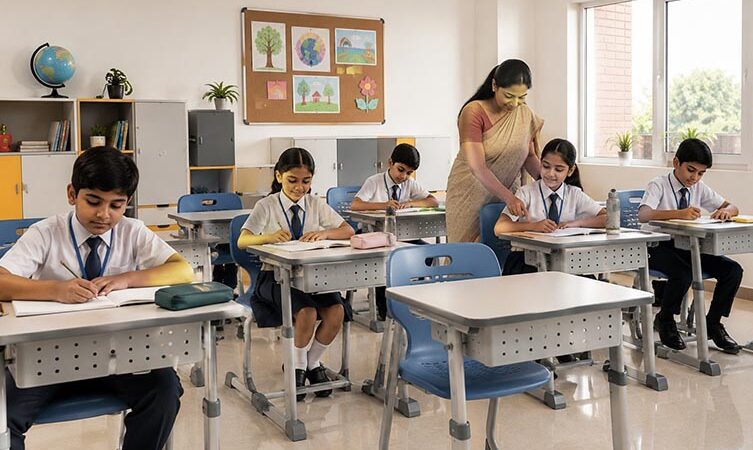
Choosing the right school furniture is no longer just about filling classrooms with desks and benches. In 2026, schools and colleges are increasingly focusing on student comfort, posture support, durability, and space optimization to improve learning outcomes. Well-designed furniture directly impacts attention span, classroom discipline, and overall academic performance, making it a crucial part of modern educational infrastructure.
The first and most important factor in selecting school furniture is student ergonomics and comfort. Comfortable seating plays a major role in maintaining focus during long study hours. Poorly designed furniture can lead to fatigue, discomfort, and posture issues. Institutions should look for desks and benches that provide proper seat and desk height alignment, adequate legroom, back support for extended sitting, and smooth, rounded edges for safety. Ergonomic designs help students stay attentive and comfortable throughout the learning session.
Another key consideration is the use of durable and long-lasting materials. School furniture is subjected to heavy daily usage, so strength and durability are essential. Powder-coated steel frames are widely preferred for their stability, while laminated wood or particle board ensures a smooth and clean surface finish. Scratch-resistant and water-resistant coatings further enhance longevity. High-quality materials reduce maintenance requirements and ensure that furniture remains functional for many years, even in high-traffic classrooms.
Space efficiency is also a critical aspect of modern classroom design. Schools should focus on space-saving furniture layouts that maximize seating capacity without overcrowding the room. Popular options include dual desks for two students per unit, modular seating arrangements, compact study tables, and movable furniture systems. These designs improve movement within the classroom, enhance ventilation, and create a more organized and structured learning environment.
It is also important to consider age-appropriate furniture design. Different student groups require different dimensions and features. Primary school furniture should be smaller in height, colorful, and designed with safety-focused edges. Secondary school furniture should provide standard ergonomic support with added storage options. For higher education, furniture should be more professional, spacious, and functional to support academic and technical learning requirements. Proper sizing ensures better posture and comfort across all age groups.
Safety is another essential factor that cannot be ignored. Schools must ensure that furniture meets basic safety standards, including rounded corners to prevent injuries, non-toxic materials and coatings, stable and anti-tip structures, and smooth finishes without sharp edges. Safe furniture helps create a secure and worry-free learning environment for students and teachers alike.
Modern classrooms also benefit greatly from storage and organization features. Furniture with built-in storage racks, drawers, and compartments helps students keep books, stationery, and personal items organized. Lockable storage options further enhance security and reduce clutter inside classrooms. A well-organized classroom improves discipline and makes the learning environment more efficient and pleasant.
Ease of maintenance is another practical requirement for schools. Furniture should be designed for daily cleaning and long-term upkeep. Laminated surfaces, stain-resistant coatings, and simple structural designs without complex joints make maintenance easier and more cost-effective. Low-maintenance furniture saves both time and operational costs for institutions.
Flexibility is also becoming a key requirement in modern education systems. Schools are now adopting modular and adaptable furniture designs that can be easily rearranged for group activities, different teaching methods, or classroom expansions. Flexible furniture helps create dynamic learning environments that support both traditional teaching and modern collaborative learning approaches.
Finally, schools must maintain a proper balance between cost and quality. While budget considerations are important, choosing the cheapest option often leads to frequent replacements and higher long-term expenses. Instead, institutions should focus on long-term durability, manufacturer reliability, warranty support, and overall value for money. Investing in quality furniture ensures better returns over time and improves overall classroom performance.
In conclusion, choosing the right school furniture is a strategic decision that directly influences student comfort, learning efficiency, and academic performance. In 2026, schools should prioritize ergonomic design, durability, safety, and flexibility to create better and more effective learning environments. Well-planned furniture not only improves posture and comfort but also enhances concentration, discipline, and long-term academic success.