
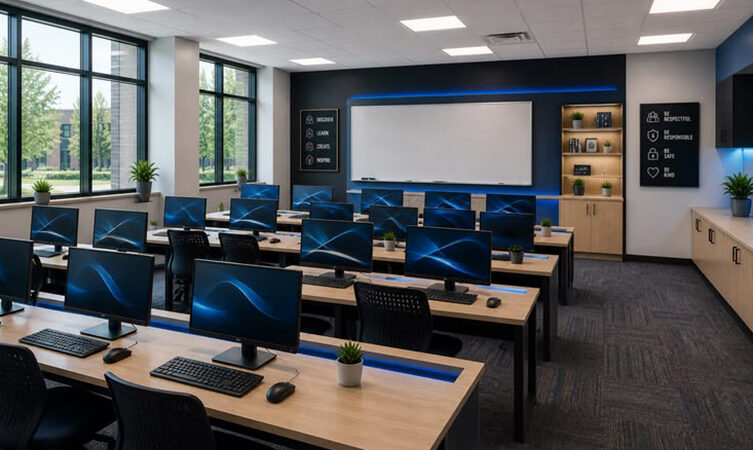
A modern computer lab in 2026 is no longer just a room filled with desktops arranged in straight rows. It has evolved into a fully developed digital learning environment that supports collaboration, comfort, safety, and long-term usability. Today’s schools and colleges require computer labs that can handle coding sessions, online examinations, AI-based learning tools, and hybrid teaching models. To achieve this, institutions must focus on thoughtful planning of space, furniture, ergonomics, power systems, and student flow.
The first step in designing an effective computer lab is smart space planning. A well-designed layout ensures proper movement between desks, clear visibility for instructors, organized cable routing, and comfortable seating capacity based on room size. Overcrowding should be avoided, as each student must have enough personal workspace to focus and work efficiently. A well-planned layout directly improves discipline, safety, and learning productivity.
Another important factor is the selection of ergonomic computer lab furniture. In 2026, educational institutions prefer modular and ergonomic designs that support long working hours without discomfort. Modern computer lab furniture should include individual or dual-user workstations, appropriate seating height, sufficient legroom, privacy partitions for better focus, and durable laminated surfaces for daily use. Strong metal or engineered wood frames ensure long-lasting performance. Well-designed workstations help reduce distractions and improve concentration during learning and assessments.
One of the most critical aspects of a computer lab is cable management and safety. With multiple systems running simultaneously, cable clutter can become a major issue if not handled properly. Modern labs should include integrated cable trays, concealed wiring systems, safe power distribution units, and surge protection mechanisms. These features not only improve safety but also give the lab a clean, organized, and professional appearance.
The choice of materials also plays a key role in durability and maintenance. Computer labs experience heavy daily usage, so furniture must be built using strong and reliable materials. Laminated particle boards are commonly used for desktops due to their smooth finish and durability, while powder-coated steel frames provide structural strength. Scratch-resistant and heat-resistant surfaces ensure long-term performance with minimal maintenance, making them ideal for institutional environments.
Modern lab design is also shifting toward flexible layouts that support different learning styles. Instead of traditional straight rows, institutions now prefer hybrid configurations such as linear rows for examinations, cluster seating for coding and group projects, and U-shaped or circular layouts for collaborative learning. This flexibility allows the computer lab to adapt easily to various teaching methods and academic requirements.
Proper lighting and ventilation are equally important in creating a productive learning environment. A well-designed computer lab should maximize natural light wherever possible while using anti-glare artificial lighting to reduce eye strain. Adequate ventilation or air conditioning ensures a comfortable temperature for both students and equipment, helping maintain focus and efficiency during long sessions.
In 2026, computer labs are also becoming more technology-driven with the integration of smart learning tools. High-speed internet connectivity, interactive displays or smart boards, cloud-based learning platforms, and digital examination systems are now common components. These technologies make the lab future-ready and aligned with modern educational standards.
Storage and organization should not be overlooked in computer lab design. Each workstation should include provisions for storing personal items, accessories, and educational materials. Lockable storage solutions help maintain discipline and security while keeping the workspace neat and clutter-free. Organized storage enhances both safety and usability.
Finally, a modern computer lab should be designed with future scalability in mind. Modular furniture systems, expandable workstation layouts, upgrade-friendly wiring, and flexible seating arrangements ensure that the lab can evolve with changing educational needs. This long-term approach helps institutions avoid frequent redesigns and supports sustainable infrastructure planning.
In conclusion, designing a modern computer lab in 2026 is about combining technology, ergonomics, durability, and flexibility. Educational institutions that invest in well-planned computer lab infrastructure create a more efficient learning environment and significantly improve student performance. A well-designed computer lab is not just a facility—it is the foundation of digital education and future-ready learning.